How Far Can One Application of Revolubes Take You?

INDEPENDENTLY TESTED BY ZERO FRICTION CYCLING

How Far Can One Application of Revolubes Take You?

Over 700 miles on dry roads? What about wet roads, dusty gravel or extreme mud? Discover how Revolubes performed in ZFC's single-application longevity testing, and what the results mean for your bicycle chain.

EXPLORE THE RESULTS ↓

SINGLE-APPLICATION LONGEVITY

One Application. Five Test Scenarios.

Estimated real-world mileage across five riding conditions. Select a result below to read the interpretation.

← Swipe to view all five results →

All figures are estimated real-world distances based on ZFC's data and approx one-third conversion guidance. The 700+ mile figure includes mathematical extrapolation. Heavy Blend refers to the tested prototype.

How Chain Wear Changes Across Riding Conditions

Each coloured line represents chain wear under a different test condition. Flatter lines indicate less additional wear over the same distance.

ZFC Revolubes single-application longevity chart, comparing chain wear against estimated real-world mileage under dry road, wet road, dry gravel and muddy off-road conditions. The horizontal red dotted line marks 0.1 mm of test wear allowance.

On mobile, swipe across the chart to read the labels.

How to read the chart

Horizontal axis: estimated real-world distance in miles. (1/3 of lab covered distance - ZFC)

Vertical axis: measured chain wear in millimetres.

Red dotted line: ZFC's 0.1 mm single-application test wear allowance.

The graph uses ZFC laboratory raw data converted to estimated real-world mileage following ZFC's approximate one-third guidance. Mathematical extrapolation of the dry-road wear trend is identified separately from measured points.

Sources and methodology: ZFC raw data and test protocol; ZFC projection and methodology; ZFC real-world distance conversion guidance.

What Do the Results Mean for Your Riding?

01 · DRY ROAD · CLEAR BLEND

700+ miles projected

Clear Blend maintained very low, consistent chain wear throughout the 2,250 km laboratory test limit without reaching ZFC's 0.1 mm wear allowance. The 700+ mile estimate is based on mathematical extrapolation of the wear trend.

Key takeaway: Outstanding estimated longevity under comparable dry-road conditions.

DISCOVER CLEAR BLEND →
02 · DRY GRAVEL / MTB / CX · CLEAR BLEND

330 miles estimated

Under dry off-road contamination, Clear Blend maintained a low wear rate across much of the test before a sharper rise towards the end, reaching approximately 0.09 mm at 330 miles.

Key takeaway: Substantial wear protection in dry, dusty off-road conditions.

DISCOVER CLEAR BLEND →
03 · WET ROAD · CLEAR BLEND

240 miles estimated

The wear curve remained relatively low initially, then increased more rapidly as the test progressed, reaching approximately 0.1 mm near 240 miles on the comparison chart.

Key takeaway: Water exposure reduces single-application longevity compared with dry-road conditions.

DISCOVER CLEAR BLEND →
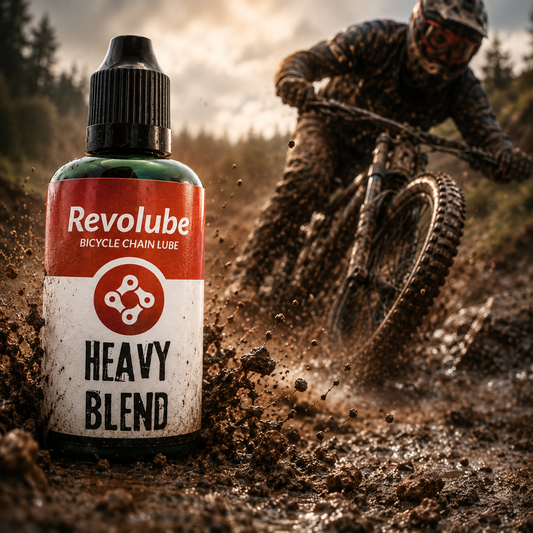
04 · MUDDY OFF-ROAD · HEAVY BLEND PROTOTYPE

120 miles estimated

The Heavy Blend prototype showed longer single-application longevity than Clear Blend alone in the muddy comparison. This is a prototype result, not a separate verification of the current retail formulation.

Key takeaway: A protective top coat can offer extra protection in demanding conditions.

LEARN ABOUT HEAVY BLEND →

05 · MUDDY OFF-ROAD · CLEAR BLEND

90 miles estimated

Heavy water and contamination exposure accelerated chain wear, with the curve approaching ZFC's 0.1 mm test allowance at around 90 miles.

Key takeaway: Extreme mud demands more frequent maintenance.

DISCOVER CLEAR BLEND →

Why Should You Care About Chain Wear?

A bicycle chain undergoes thousands of loaded movements as you pedal. Contamination can increase abrasion inside the chain, contributing to elongation and wear on drivetrain components.

Maintaining low abrasive wear over time may help extend the service life of your chain, cassette and chainrings. ZFC's longevity test measures wear, not watts saved.

What Is the Jump Point?

Some lubricants produce very little wear for several intervals before showing a sudden rise. ZFC calls this change the Jump Point.

That is why the shape of the wear curve matters, not just the final distance at which the test wear allowance is reached.

How Does ZFC Test Lubricant Longevity?

ZFC uses a controlled drivetrain and calibrated trainer so lubricants can be compared under repeatable conditions. Its updated Single Application Longevity protocol includes clean, dry-contaminated and extreme-contamination stages.

250 WControlled test load
150 kmWear-check intervals
7 pointsChain measurement locations
0.01 mmDigital measuring resolution

For the SAL protocol, lubricant is applied ultrasonically; dry contamination uses sandy loam and the extreme stage adds water plus abrasive material. Each stage uses an additional 0.1 mm wear allowance. The test results are comparative, not guaranteed road-mileage intervals.

More about the three test conditions

Clean: Ultrasonically lubricated chain, no deliberately added contamination.

Dry contamination: 5 g of sandy loam added at the beginning and after each 150 km interval.

Extreme contamination: 1,000 ml of water and 10 g of dry contamination added at the beginning and after each 150 km interval.

Which Revolubes Blend Is Right for You?

Clear Blend

Versatile lubrication for road, gravel, MTB and everyday cycling, including the test conditions shown above.

SHOP CLEAR BLEND →

Wet Blend

Designed for frequent wet riding and greater water washout resistance. Not independently represented on this chart.

EXPLORE WET BLEND →

Heavy Blend

A dense protective top coat for especially harsh, muddy conditions. Apply over a suitable penetrating chain lubricant.

EXPLORE HEAVY BLEND →

Frequently Asked Questions

Can I really ride over 700 miles on one application?

It is a mathematical projection from the dry-road laboratory wear trend, not a guaranteed riding interval. Actual mileage depends on conditions, load, contamination, application and maintenance.

What does the 0.1 mm line mean?

It is ZFC's additional wear allowance for a Single Application Longevity test stage, not a chain replacement threshold.

Were these distances measured on the road?

No. ZFC used controlled laboratory testing. Revolubes converted the recorded distance into an estimated real-world equivalent following ZFC's approximate one-third guidance.

Does lower wear mean fewer watts lost?

Not as a direct numerical conversion. Abrasive friction contributes to wear and drivetrain losses, but ZFC's SAL protocol measures wear rather than power losses.

Does Heavy Blend replace Clear Blend?

No. Heavy Blend is intended as a protective top coat over a properly lubricated chain, rather than as a substitute for initial lubricant penetration.

Don't Just Lubricate Your Chain.
Protect Your Drivetrain.

Discover the right Revolubes blend for your riding conditions.

FIND YOUR PERFECT BLEND →